What's in a CBOM, and how QuantaCipher Insight generates one
Generating a Cryptographic Bill of Materials (CBOM) is now a hard regulatory requirement. Learn how QuantaCipher Insight automates CBOM generation for enterprise environments.
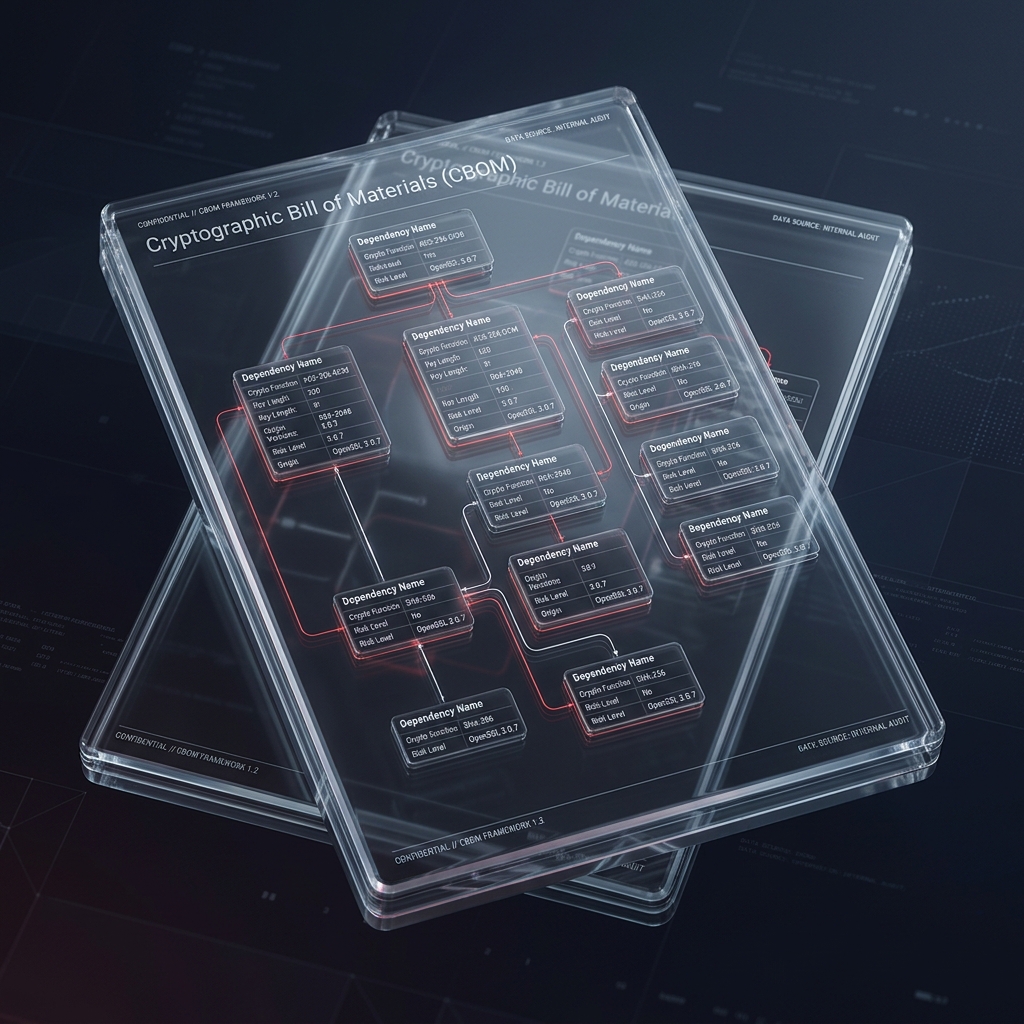
The discovery phase is the mandatory first step of any cryptographic migration. Before you can transition to Post-Quantum Cryptography (PQC), you need absolute clarity on what legacy cryptography currently exists across your architecture. You cannot migrate cryptography you don't know you have.
This is where a Cryptographic Bill of Materials (CBOM) becomes critical.
What is a CBOM?
A CBOM is a structured, machine-readable inventory of every cryptographic asset within a codebase or system. It tracks algorithms, key sizes, protocols, libraries, certificates, and their intricate dependency relationships.
Importantly, CBOM is not a proprietary format. It is an official extension of the open-source CycloneDX standard, introduced in version 1.6 to sit alongside traditional Software Bills of Materials (SBOMs). It was designed by the community to enforce crypto-agility and provide standardized quantum readiness assessments.
Inside the CycloneDX CBOM Schema
When you look inside a standard CycloneDX CBOM JSON, you will find several critical fields mapping your cryptographic posture. The core components include:
- Algorithms and Parameters: Explicit declarations of primitive usage (e.g.,
RSA-2048,AES-128-CBC,ECDSA). nist_quantum_security_level: A critical CycloneDX property that categorizes the security strength of a cryptographic algorithm against quantum computational attacks based on NIST evaluation criteria.- Keys and Certificates: Mapping embedded secrets, X.509 certificate chains, and their specific signature schemes.
- Protocols in Use: Documenting TLS versions, negotiated cipher suites, and KDFs.
- The Dependency Graph: The precise mapping linking the cryptographic primitives to the exact application code or third-party libraries invoking them.
How CBOM Generation Works Technically
Generating a comprehensive CBOM typically relies on static source-code analysis. An analysis engine-such as the open-source IBM/PQCA CBOMkit-parses your application into an Abstract Syntax Tree (AST). It then uses pattern-matching engines to detect cryptographic API calls, scanning for imports like crypto, openssl, or jsonwebtoken.
Once identified, the engine traces the data flow to determine the specific parameters (like key sizes and padding schemes) being used. It also scans deployment artifacts (such as static .pem files or embedded secrets) to build a fuller picture.
The Limitation of Static Analysis It is important to state clearly that static analysis alone is not a silver bullet. It can miss dynamically loaded cryptographic libraries, highly obfuscated code, or dependencies resolved entirely at runtime. True crypto-agility requires pairing static scanning with dynamic runtime monitoring.
How QuantaCipher Insight Automates Discovery
QuantaCipher Insight operationalizes this standardized discovery phase. Our tooling implements the CycloneDX standard to generate precise, actionable CBOMs directly from your workflows.
Instead of manually configuring open-source AST parsers, teams can run a scan effortlessly:
- Connect your Repository or upload a ZIP archive of your source code directly to the QuantaCipher Insight engine.
- Insight executes a deep static analysis across your codebase and dependencies.
- A standardized CycloneDX v1.6 CBOM is generated, indexing every cryptographic asset.
Bridging to Migration Planning
A CBOM is only as valuable as the action it drives. QuantaCipher Insight feeds the generated CBOM directly into your migration planning workflow.
Every flagged legacy algorithm (e.g., an RSA-2048 signature or a deprecated SHA-1 hash) becomes a scored risk item. The platform then automatically maps out a concrete migration path from the vulnerable legacy primitive to a quantum-resistant standard, such as FIPS 203 (ML-KEM) or FIPS 204 (ML-DSA).
Finally, remember that a CBOM is not a one-time, static artifact. Crypto-agility means keeping your inventory current as code continuously evolves, ensuring that new legacy cryptography isn't silently reintroduced into production.